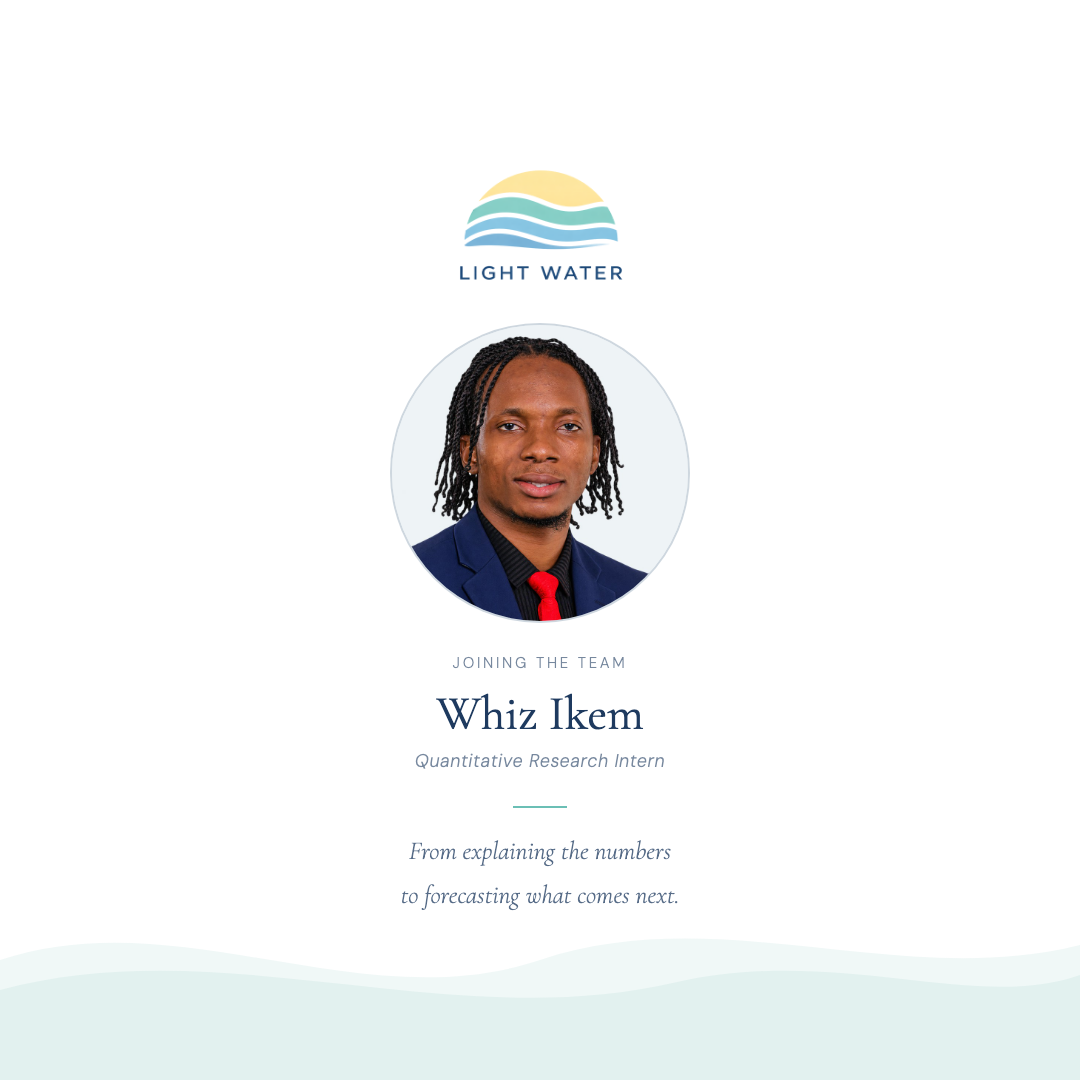
We're pleased to announce that Chinedu “Whiz” Ikem has joined Light Water Capital as a Quantitative Research Intern on our Systematic Strategies team.
Whiz joined on November 9 and works with us remotely from London. He started in accounting, earning his bachelor's and master's degrees in the field in Nigeria, and spent several years as a finance and risk analyst and then a data research analyst, working with lending, repayment and cash-flow data. That work pulled him toward code and models, and he went on to complete an MSc in FinTech and Finance at the University of Greenwich, where he founded the FinTech Innovators Society and received the school's Making a Difference award. He currently works as a data scientist at AMDARI.
As he puts it, accounting taught him to explain what happened to the numbers; quantitative analysis lets him ask what might happen next. His recent research forecast next-day volatility across four crypto assets with a mix of econometric, machine-learning and deep-learning models, turned the forecasts into a volatility-targeted portfolio, and ran it as a live paper-trading system. He's candid that it manages risk rather than finds alpha, and that's the question he brings to us: once you know how much risk to take, where should you take it?
What Whiz Will Be Working On
Whiz's time is split evenly between two tracks.
The first is collaborative. Working directly with our founder, Whiz will help lead our ongoing volume research. Several projects are already collecting data every morning, including a time-of-day relative-volume scan across sector and theme ETFs, and his job is to take that work to the next level: testing measures such as relative volume and signed volume imbalance, how volume responds to macro releases and surprises, and whether any of it holds up as a tradeable signal at weekly, monthly or quarterly horizons. The work is exploratory, and ruling an idea out counts as a result.
The second is independent. Whiz will take ownership of his own strategies in common stocks and ETFs, from idea through backtest. Candidate strategies go through walk-forward, Monte Carlo and regime testing with our in-house tools, including July Backtester, our open-source Python engine, and are brought to the Monday team call for the rest of us to try to break.
Building the Team
We hire for impact, not headcount. Interns here get real responsibility early, and we say so publicly: we acknowledge them on LinkedIn, write about the work they produce, and encourage them to publish under their own byline in The Dispatch. That includes Whiz, and we hope to share his research here as it develops.
Welcome to the team, Whiz. We're looking forward to seeing what you build.
Leave a comment - join the conversation
Share your thoughts, questions, or insights on this article. We'd love to hear your perspective.
Comment on LinkedIn